
Wheel Alignment and Balancing Explained
You may think wheel alignment is the same as wheel balancing, but they are actually two completely different services. They are generally done during the same service, but they have different purposes.
A wheel alignment corrects the angles of your tyres while wheel balancing corrects the weight imbalance of your tyres. It’s important to understand the difference between them as both impact your car’s handling, safety and tyre wear.
What is a wheel alignment service?
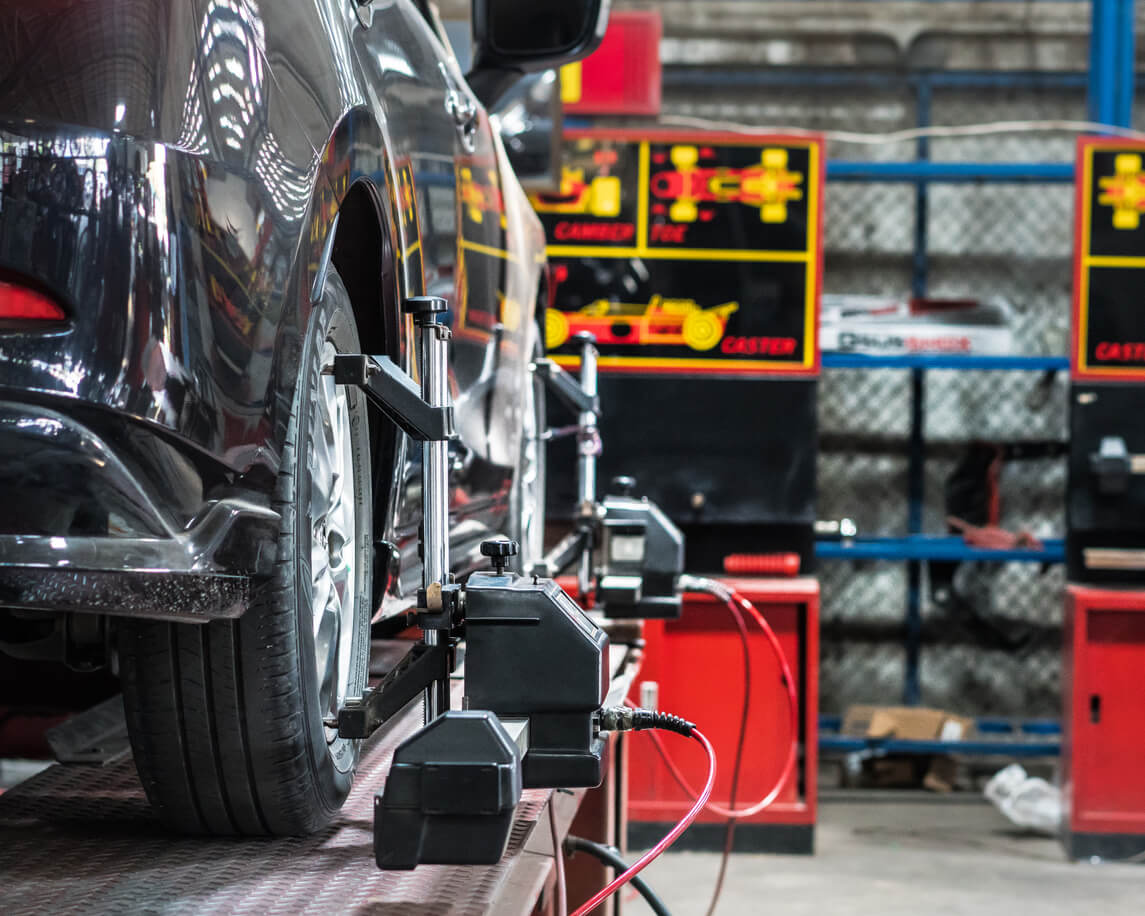
In a wheel alignment service, the suspension components of your car are adjusted. This includes any suspension arms and linkages. These components are the ones that connect your car to its wheels and keep everything where they’re meant to be.
By measuring, analysing and adjusting your vehicle’s steering and suspension angles, a wheel alignment service will make sure your tyres make optimal contact with the road surface.
Depending on the make and model of your vehicle, there are different adjustment methods. However, there are three key measurements that need to be taken: caster, camber, and toe.
- Camber. This is the inwards or outwards tilt of the angle of the tyre when viewed from the front of the vehicle. Too much negative or positive camber will accelerate wear on the edges of the tyre. Camber misalignment can sometimes be caused by worn suspension components, such as suspension springs, shock absorbers, bolt joints, and so on.
- Toe. This refers to how much the wheel angle is in or out from the car's centre line. Cars with excessive toe-in or toe-out can experience rapid tyre wear. Toe alignment is often affected by your tie-rods, at each end of your steering rack, or worn-out ball joints.
- Caster. This helps with straight line stability and the steering wheel returning to the center position. Caster angles that are out of adjustment usually won’t cause tyres to wear but may cause the vehicle to pull to one side if the tyre caster angles differ greatly between the two front wheels. Caster can also affect steering effort.
What is a wheel balancing service?

The distribution of mass within a vehicle's tyre or the entire wheel on which it’s placed is referred to as wheel balance, also known as wheel imbalance or wheel unbalance.
In mass-produced products such as tyres and wheels, there is the potential for somewhat different weight distributions in different areas. When driving, this variation in weight distribution can generate vibration and shake.
In order to counteract this, the wheels are fitted with wheel weights. This is known as wheel balancing or tyre balancing. A special machine is used to measure any imbalance and how much weight should be added.
Generally, there are two types of imbalance:
- Dynamic imbalance. This imbalance happens when there is unequal weight distribution on one or both sides of a tyre and wheel assembly, leading to a wheel shimmy. You’ll notice this type of imbalance when you feel a wobbling or side-to-side vibration.
- Static imbalance. This imbalance happens when there is a light or heavy spot in the tyre. This will cause your tyre to roll unevenly, and the wheel will undergo an up-and-down motion. You’ll notice this type of imbalance when you feel a hop or vertical vibration.
Should you book a wheel alignment and balancing service at the same time?
It’s recommended you have a wheel balance and alignment performed every time you get new tyres fitted to your vehicle. This will improve not only your car’s overall performance and safety, but also ensure your vehicle handling, fuel efficiency, and tyre life will be maximised.
Wheel balancing and alignment services are also ideal when you have your tyres rotated and when you need to reinstall a tyre that has had a puncture repaired.
Signs you need a wheel alignment
There are some reasons, besides routine alignments, that you might think about scheduling a wheel alignment service. For example:
- If the steering wheel is straight and your car is veering to one side or the other.
- If you notice a significant change in how the car "feels" while driving.
- If you strike a curb while parking.
- The car pulls to one side when driving.
- If your car hits a pothole, as this could possibly harm the suspension or cause the car to become out of alignment.
Signs you need a wheel balance
When the wheel rotates while driving, differences in its weight distribution may cause periodic forces and torques to be applied to the axle, resulting in the symptoms listed below.
- Car disturbances, usually felt as vertical and lateral vibrations.
- Oscillations in the steering wheel, which sometimes happen at particular speeds, fast or slow.
- Uneven or faster tread wear.
Book a wheel alignment and balancing service with Tony's Tyre and Autocare.
Here at Tony's Tyre and Autocare, we are your local automotive tyre, mechanical and trailer experts servicing Quakers Hill and the surrounding region including, Blacktown, Mount Druitt, Castle Hill, Rouse Hill and Box Hill.
You can find our workshop at 1/402 Quakers Hill Pkwy, Quakers Hill with lots of convenient access and easy parking. Phone us on 02 9837 4455 to book your vehicle to see us, today!